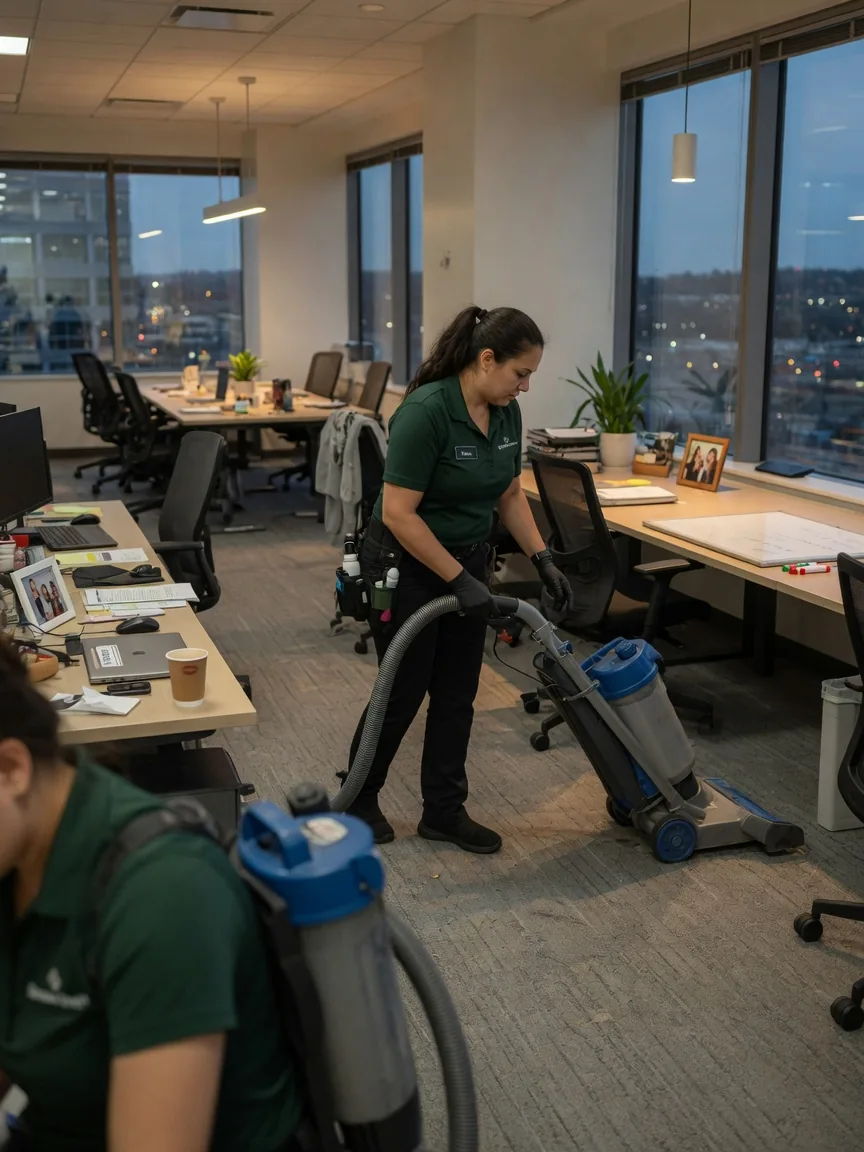
What actually drives the right office cleaning frequency?
There is no single "correct" frequency for every office. The right schedule is the one that keeps your space presentable, healthy, and client-ready without paying for visits you don't need. A few factors do most of the work in setting it.
How does headcount and foot traffic change the schedule?
More people in a space means more waste, more restroom use, more high-touch contact, and faster soiling of floors and common areas. A quiet back-office suite with a handful of staff can often run well on two or three visits a week. A busy open-plan floor, a reception area that sees clients all day, or a shared lobby in a multi-tenant building usually justifies daily service — and sometimes a day porter on top of nightly cleaning.
As a rough rule: the more people move through a space and the more of them are visitors rather than staff, the higher the frequency needs to be.
Does office type and layout matter?
Yes. A law or accounting firm where clients visit and discretion matters is held to a different standard than a warehouse mezzanine office. Open-plan layouts spread soil and germs faster than closed private offices. Class A and multi-tenant buildings carry shared lobbies, elevators, and restrooms that have to stay presentable through the business day, not just overnight.
Medical and dental front-office areas sit in their own category — waiting rooms and reception get cleaned to a higher standard and coordinated with any clinical disinfection, which is a different service tier. (See our medical office cleaning page for the higher-compliance side of that work.)
Client-facing vs. back-office areas
Split your floor plan in your head into what visitors see and what only staff see. Lobbies, reception, conference rooms, and client restrooms are first-impression surfaces — they tend to need daily attention or a day porter. Back-office storage, private offices, and low-traffic corridors can often run on a lower frequency without anyone noticing.
Right-sizing a program usually means cleaning the client-facing zones more often than the back-of-house, rather than applying one blanket frequency to the whole space.
High-touch surfaces
Door handles, light switches, elevator buttons, shared keyboards and phones, break-room appliance handles, and reception counters are the surfaces hands actually land on. Published CDC guidance recommends high-touch surfaces be cleaned at least once a day, and more frequently in high-traffic areas. In practice this means high-touch disinfection belongs in every service visit for an occupied office, not on a weekly or monthly cadence.
Restrooms, break rooms, and kitchens
Restrooms and break rooms are the two areas where under-cleaning is most visible and most damaging. Both should be cleaned and sanitized daily in any occupied office, with consumables (paper, soap, liners) checked every visit. A high-traffic restroom — larger teams, client foot traffic, limited stalls — may need servicing more than once a day. Break-room and kitchen surfaces, sinks, and shared appliances are daily touch points as soon as the room sees regular use.
Floors and carpet
Vacuuming and hard-floor care track with traffic — entryways and heavily used walkways often need daily attention, while lower-traffic carpet can run weekly. Deep floor work is a separate, periodic layer: carpet extraction and hard-floor refinishing are typically scheduled quarterly or semi-annually, not as part of the routine visit. For the periodic side, First Choice handles this through commercial floor cleaning scheduled around the routine janitorial services program.
Daily vs. weekly vs. monthly vs. quarterly: a task cadence table
The practical way to think about office cleaning frequency is not "how often is the office cleaned" but "how often is each task done." A well-built janitorial program layers tasks at different cadences. The table below reflects a typical occupied professional office; your scope is set to your facility during the walkthrough.
| Task | Daily | Weekly | Monthly | Quarterly / Periodic |
|---|---|---|---|---|
| Restroom clean & sanitize | ● | |||
| Restock consumables (paper, soap, liners) | ● | |||
| Trash & recycling removal | ● | |||
| High-touch surface disinfection | ● | |||
| Break room / kitchen surfaces & sinks | ● | |||
| Entryways, lobby & reception detailing | ● | |||
| Vacuum high-traffic carpet & walkways | ● | |||
| Empty / spot-clean desks & common surfaces | ● | |||
| Full-floor dusting (low surfaces) | ● | |||
| Glass, partitions & interior doors | ● | |||
| Vacuum low-traffic carpeted areas | ● | |||
| Detailed restroom fixtures & grout | ● | |||
| High dusting (vents, ledges, light fixtures) | ● | |||
| Baseboards & detailed edge work | ● | |||
| Upholstery / fabric spot care | ● | |||
| Carpet extraction / deep carpet clean | ● | |||
| Hard-floor strip, wax or refinish | ● | |||
| Tile & grout deep clean | ● |
Cadence is illustrative of a typical occupied office and is set to your facility, headcount, and traffic during the walkthrough. Lower-occupancy suites may shift several "daily" rows to two or three visits a week.
When do you need more frequent cleaning? (signs to watch)
Some offices outgrow their schedule, and the signs usually show up before anyone formally complains. Watch for:
- Restrooms running out of supplies between visits, or looking used by mid-afternoon.
- Visible soil in high-traffic lanes — entry mats, main corridors, elevator thresholds — within a day of service.
- Break-room and kitchen buildup — overflowing bins, sticky counters, a full sink by lunch.
- Rising sick days clustering through a season, which points to high-touch surfaces not being disinfected often enough.
- Headcount or layout changes — you added staff, took another floor, or opened a space to client visits.
- Client-facing complaints or comments, which are the most expensive signal because a prospect noticed before you did.
Any of these is a cue to raise frequency in the affected zones — often just the client-facing areas or restrooms — rather than the whole program.
Restrooms and break rooms: the special cases
These two areas deserve their own note because they drive perception out of proportion to their square footage. A spotless office with a neglected restroom still reads as a neglected office to a visitor, and industry research has long shown that a poor restroom experience measurably changes how people judge a business.
The practical standard: restrooms and break rooms get cleaned, sanitized, and restocked daily in any occupied office, and high-traffic restrooms get serviced more than once a day or covered by a day porter. These are the areas where cutting frequency to save budget costs the most in reputation.
Disinfection and cold-and-flu-season considerations
Routine cleaning removes most of what's on a surface; disinfection is the added step for high-touch points and higher-risk seasons. Published CDC guidance treats regular daily cleaning as sufficient for most office situations, with disinfection layered on for high-touch surfaces and when illness is circulating.
In practice, that means a standing program should disinfect high-touch surfaces on every visit year-round, and step up disinfection frequency and coverage during cold-and-flu season — roughly the late-fall through winter stretch when staff are indoors and illness spreads fastest. For offices that want it, enhanced disinfection protocols can be added seasonally rather than carried all year.
How does South Florida's climate affect office cleaning frequency?
South Florida's environment changes the math in ways that inland markets don't deal with, and it's worth building into the schedule rather than discovering the hard way.
- Humidity and mold risk. Year-round high humidity means moisture lingers — in entry mats, carpet, grout, break-room sinks, and anywhere HVAC condensation collects. Damp areas that sit between infrequent visits are where mildew and odor start. In a humid climate, keeping restrooms, kitchens, and entry areas on a daily cadence is as much about moisture control as appearance.
- Pollen and outdoor debris. South Florida's long growing season pushes pollen and fine outdoor dust indoors, settling on surfaces and working into carpet and entry mats. Offices here often need more frequent dusting and entry-mat/floor attention than the same office would in a drier climate.
- Hurricane season. June through November brings wind-driven debris, water intrusion, and post-storm cleanup spikes. Facilities in the tri-county area should factor storm-season surge cleaning — and the occasional one-off deep clean after a storm — into how they think about their provider, even if it's not part of the weekly cadence.
- Year-round occupancy. Unlike seasonal markets, South Florida offices run at full occupancy all year, so there's no natural "slow season" where frequency can safely drop. Demand is steady across Palm Beach, Broward, and Miami-Dade.
The short version: in this climate, the humidity-exposed and outdoor-facing areas of an office generally justify a higher baseline frequency than a national rule of thumb would suggest.
How do you right-size a cleaning schedule with a provider? (the walkthrough)
The schedule shouldn't be guessed from a phone call. A good provider sets it from a walkthrough. Here's what that looks like:
- On-site walkthrough. The provider walks your space, notes headcount, foot traffic, client-facing zones, restroom and kitchen load, floor types, and any compliance needs.
- Zone the floor plan. Client-facing and high-traffic zones get mapped to a higher frequency than low-traffic back-office areas — you're not paying one blanket rate for the whole footprint.
- Set task cadences, not just a visit count. Daily tasks, weekly tasks, and periodic deep work get written out explicitly (like the table above), so you know exactly what happens when.
- Written scope and SLA. The agreed frequency goes into a written scope and service-level agreement, so "how often" is documented and measurable, not a hope.
- Review and adjust. As headcount, layout, or season changes, the schedule flexes with you — raising frequency in the zones that need it rather than renegotiating the whole contract.
This is how a recurring business office cleaning program is built: scoped to your facility, written down, and adjusted as your office changes.