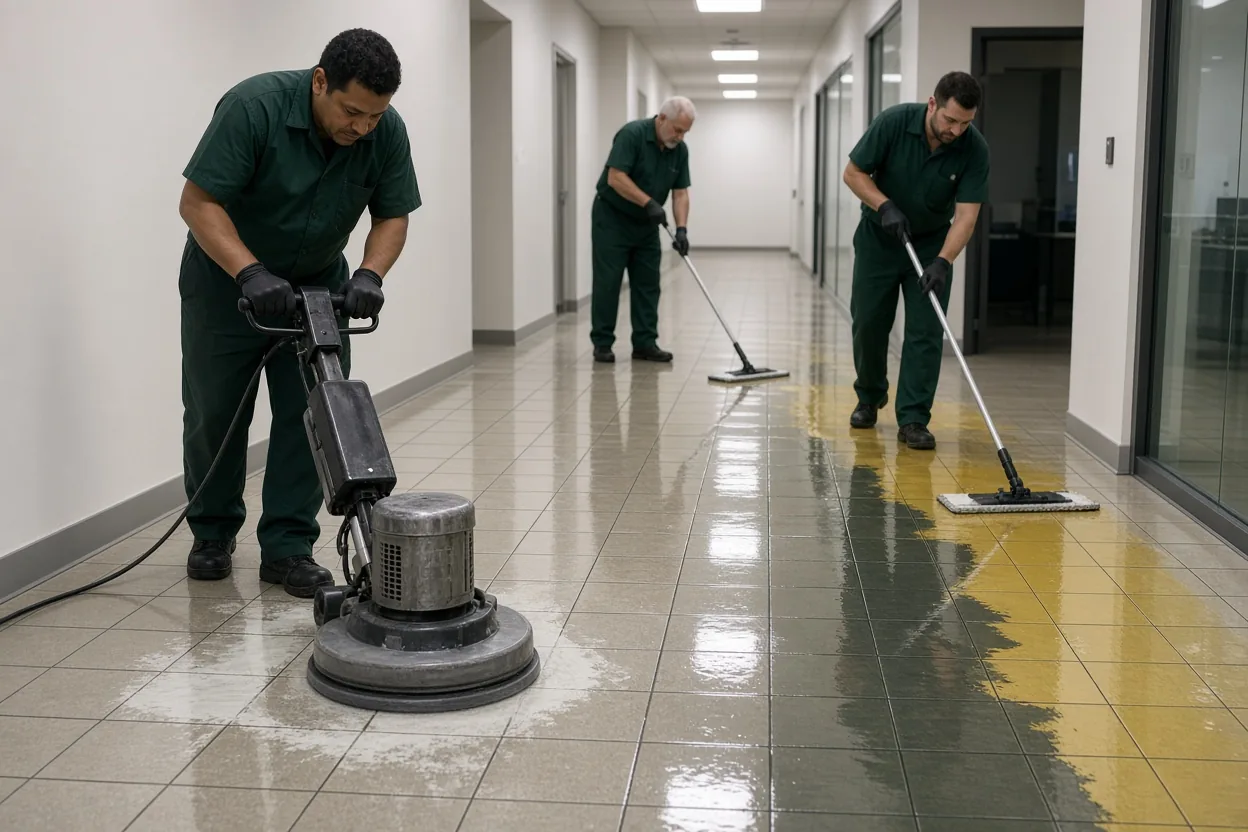
Commercial floor strip-and-wax runs roughly $0.30 to $1.00+ per square foot for most standard jobs, with small jobs, premium high-solids finishes, and sealed concrete pushing well above that. The reason the range is that wide is not vagueness — it's that the price is driven almost entirely by variables specific to your floor: how much old finish has to come off, how many coats go back on, how big the area is, and how much furniture and tight detail work the crew has to deal with.
That's why two bids on the same building can land at $0.30 and $1.00 and both be honest. The cheaper one is often quoting less work. Below is how to tell what you're actually paying for, so you can compare bids on scope instead of on a single headline number.
What's a realistic per-square-foot range in 2026?
Published pricing guides this year cluster in a consistent band. Excellence Janitorial Services (dated June 9, 2026) puts standard commercial strip-and-wax at $0.30 to $0.80 per square foot, with premium finishes at 85¢ and up. ForemanPro (dated Aug 12, 2026, updated Sep 20, 2026) gives a broader $0.50 to $3.00 per square foot overall, narrowing to $0.50 to $1.50 for VCT and $0.75 to $3.50 for sealed concrete.
Both sources point back to the same thing: a per-square-foot number means little until someone has walked the floor. ForemanPro is explicit that a proposal should come from an on-site evaluation, not a generic rate. That matters in a building where some rooms are fine and others have years of yellowed buildup — a blended "whole-building rate" hides which is which.
For planning purposes, two example totals from Excellence Janitorial Services (June 9, 2026) give a feel for the math at scale:
| Area | Example total (Excellence Janitorial Services, June 9, 2026) |
|---|---|
| 5,000 sq ft | ~$1,500–$4,000 |
| 15,000 sq ft | ~$4,500–$9,000 |
Notice the per-square-foot rate falls as the job grows. That's economies of scale, and it's one of the biggest reasons small jobs feel expensive — more on that below.
Strip-and-wax vs. scrub-and-recoat: which do you actually need?
This is the single most important question for your budget, because many facility managers pay for a full strip when a scrub-and-recoat would have done the job.
A full strip-and-wax removes all existing floor finish down to the tile with stripping solution and a floor machine, then rebuilds it with multiple fresh coats. It's the labor-intensive option — Excellence Janitorial Services (June 9, 2026) notes labor runs 70–80% of the bill — and it's the right call when the finish is heavily yellowed, built up unevenly, gouged, or so far gone that recoating would just seal in the damage.
A scrub-and-recoat (also called a "top scrub") skips the stripping step. The crew machine-scrubs off the top layer of soil and worn finish, then applies one or two fresh coats over the existing base. Because it drops the most labor-intensive part of the process, it's materially cheaper — industry pricing guides in 2026 put it at roughly $0.15 to $0.30 per square foot for a light maintenance recoat, up to around $0.90 per square foot for a heavier one. It's appropriate when the existing finish is intact but dulled, scuffed, or thinning — not when it's failing.
The practical rule: strip when the base is compromised, recoat when it's just tired. A contractor worth hiring will tell you which one your floor needs, and won't sell you a strip you don't need — or a recoat dressed up as a strip. For the ongoing version of this, see our commercial floor cleaning service.
What drives the price up or down?
The spread between a $0.30 floor and a $1.00+ floor comes down to a handful of factors. Here's what pushes the number in each direction.
Floor condition and buildup
The more old finish and embedded soil the crew has to strip, the more passes, solution, and labor it takes. A floor stripped on schedule is cheaper per square foot than one neglected for five years.
Number of finish coats
Finish is applied in coats, and each coat is time plus material. Excellence Janitorial Services (June 9, 2026) estimates each additional coat of wax adds roughly 10–25¢ per square foot. A four- or five-coat high-traffic lobby costs more per square foot than a two-coat storage area — by design, because it will last longer.
Finish grade
A premium high-solids finish — the kind that holds a harder gloss and resists scuffing longer — adds cost. Excellence Janitorial Services (June 9, 2026) puts the premium bump at roughly 20–50¢ per square foot over a standard finish.
Square footage (economies of scale)
Mobilization, setup, and equipment are largely fixed. Spread across 15,000 square feet, they're cheap per foot; across 800, they're not. This is why the example totals above show the rate dropping as the area grows.
Scheduling
Floor work shuts down the area while it dries and cures. If the crew has to work after-hours, overnight, on weekends, or in phased sections so your operation keeps running, that premium shows up in the bid. A building that can be fully vacated for a weekend is cheaper to refinish than one that must stay half-open.
Furniture, edges, and job density
Moving desks, shelving, and fixtures is labor the crew isn't spending on the floor. So is hand-detailing edges, corners, and baseboards that a machine can't reach. And open floor is faster than cluttered floor — Excellence Janitorial Services (June 9, 2026) cites crews covering about 200 sq ft/hour in open space vs. ~125 sq ft/hour in cluttered space. An empty warehouse bay and a furnished cubicle farm of the same size are not the same job.
Does the floor type change the price?
Yes — and more importantly, floor type determines whether strip-and-wax is even the right process.
VCT (vinyl composition tile) is the classic strip-and-wax surface — the speckled hard tile in schools, offices, retail back-of-house, and medical corridors. It's built to be stripped and refinished periodically, and it's where the per-square-foot ranges above apply most cleanly. ForemanPro (Aug 12, 2026) puts VCT at $0.50 to $1.50 per square foot.
Sealed concrete can also be stripped and recoated, but it typically runs higher — ForemanPro (Aug 12, 2026) cites $0.75 to $3.50 per square foot — because of surface prep and the sealers involved.
A critical caveat for comparing bids: polished concrete and luxury vinyl plank (LVP) are not strip-and-wax floors. Polished concrete is mechanically ground and densified, then maintained with specialized pads and conditioners — it has no wax layer to strip. If you want that surface, that's commercial concrete polishing, a different process with different pricing. LVP is maintained with cleaning and occasional refinish products, not a strip-and-wax cycle. Any "strip-and-wax price" quoted for these surfaces is a sign the contractor hasn't identified your floor correctly — those numbers aren't comparable to a VCT bid.
Is a maintenance program cheaper than stripping every year?
For most facilities, yes — a recurring floor-care program lowers the long-run cost per square foot and stretches out how often you need a full strip.
The logic is straightforward. Regular buffing and periodic scrub-and-recoats keep the finish intact, so soil and wear never reach the point where a full strip is the only fix. Since the strip is the most labor-intensive and expensive step, pushing a full strip from every year out to every two or three years takes real money off the annual floor budget. You're trading a handful of low-cost maintenance visits for one avoided high-cost strip.
A one-time strip-and-wax is the right call to reset a neglected floor or restore a space before a lease turnover. But if you own the building's floors for the long haul, a program is almost always the lower total cost — and the floor looks better in the meantime because it never gets to the "overdue" stage. This is the recurring side of commercial floor stripping and waxing.
Why do small jobs cost so much more per square foot?
Because the fixed costs of showing up don't shrink with the floor. A crew, a truck, machines, stripping solution, and finish have to be mobilized whether the job is 400 square feet or 14,000.
That fixed cost is why small jobs carry a minimum. ForemanPro (Aug 12, 2026) cites a typical minimum service charge of $250 to $500 regardless of area. And Excellence Janitorial Services (June 9, 2026) notes that very small jobs under roughly 400 square feet can effectively reach $1.72 to $2.15 per square foot or more once the minimum is spread across the area — a figure ForemanPro also flags as a January 2026 benchmark under certain conditions. If your project is a single small room, expect to pay the minimum, not a bargain per-foot rate.
Why is the cheapest quote usually the riskiest?
Because the easiest way to quote a low number is to do less work — and you won't see what was skipped until the finish fails.
The cost-cutting shows up in predictable places: a floor under-prepped so the old finish isn't fully removed, a scrub-and-recoat billed as a full strip, too few finish coats so the floor dulls in months, and a streaky or hazy result from rushing the cure. When the finish peels or yellows early, you pay a second crew to redo it — the cheap job becomes the expensive one. There's also the exposure of an uninsured crew handling slippery stripping chemicals in your occupied building.
So before you sign, confirm what's actually in scope: full strip vs. recoat, the number of finish coats, prep and edge detailing included, drying/cure time built into the schedule, and that the crew is bonded and insured. First Choice's floor-care crews are bonded and insured.
How do you read and compare a strip-and-wax quote?
Line items, not a lump sum. A one-line "$X to strip and wax the floors" tells you nothing about what you're buying and makes two bids impossible to compare. Ask every bidder to spell out:
- True strip vs. scrub-and-recoat — stated plainly, so you know the two bids are the same process.
- Coat count — how many coats of finish go back down.
- Prep included — edge and baseboard detailing, furniture moving, and whether those are in the price or extra.
- Scheduling — after-hours/weekend/phased work and any premium that carries.
- Square footage basis — the actual area measured, so the per-foot math is verifiable.
When all bids itemize that way, the "expensive" one often turns out to be the only complete one. For context on the day-to-day upkeep that extends a floor's life between refinishes, see commercial floor cleaning.