What regulations govern medical office cleaning?
Medical office cleaning sits at the intersection of four published frameworks. None of them is optional, and a vendor that can't name them is a vendor you're training on your own dime.
- OSHA Bloodborne Pathogens Standard — 29 CFR 1910.1030. Governs any worker with reasonably anticipated exposure to blood or other potentially infectious materials. It requires a written exposure control plan, PPE, a Hepatitis B vaccination offer, and documented annual training (OSHA, 29 CFR 1910.1030).
- OSHA Hazard Communication Standard (HazCom) — 29 CFR 1910.1200. Covers the chemicals a cleaning crew brings on-site: Safety Data Sheets (SDS) for each product, proper labeling, and staff trained on safe handling.
- CDC environmental infection-control guidance. Sets operational expectations for healthcare spaces — EPA-registered disinfectants used per label, a clean-to-dirty direction, and more frequent attention to high-touch surfaces (CDC, Environmental Services).
- EPA-registered disinfectants. Products must be EPA-registered for the pathogens of concern, applied for the contact time printed on the label (EPA, Selected EPA-Registered Disinfectants).
- HIPAA. Determines whether the cleaning vendor needs a Business Associate Agreement, based on whether its staff will use or disclose protected health information (HHS, Business Associates).
These are published federal standards and agency guidance, not any one company's internal policy. A compliant vendor's job is to operate inside them and prove it with documentation.
OSHA bloodborne pathogens — what a compliant vendor must have
OSHA's Bloodborne Pathogens Standard, 29 CFR 1910.1030, applies whenever an employee could reasonably be expected to contact blood or other potentially infectious materials during their work. For a medical cleaning crew — emptying exam-room trash, wiping surfaces, servicing restrooms — that exposure is foreseeable, so the standard is in scope.
A compliant cleaning vendor should be able to show you:
- A written Exposure Control Plan covering the exposure determination, how the standard's requirements are implemented, and the procedure for evaluating an exposure incident — reviewed and updated.
- PPE provided at no cost to the worker — gloves and other protective equipment appropriate to the task, supplied and replaced by the employer.
- A Hepatitis B vaccination offer made available at no cost to employees with occupational exposure, generally within 10 working days of assignment, after training.
- Documented training — at hire and at least annually, provided at no cost during working hours, with records kept.
- Universal precautions and safe handling — treating all blood and body fluids as potentially infectious, with defined procedures for spills and contaminated materials.
Source for the above: OSHA, 29 CFR 1910.1030 and OSHA's Bloodborne Pathogens general guidance.
What's the vendor's responsibility — and what stays with the practice?
This boundary matters, and honest vendors state it plainly. The cleaning crew handles general facility cleaning, surface disinfection, and non-regulated (ordinary) waste. Regulated medical waste — sharps, biohazard/red-bag waste, anything saturated with blood or OPIM — is handled by the practice's own licensed medical-waste program, not the janitorial crew. Sharps containers are filled and managed by clinical staff and collected by a licensed medical-waste hauler. A cleaning company that tells you it will "take care of the biohazard waste" is either misunderstanding the rules or cutting a corner you'll own later. The right answer from a vendor is: we clean and disinfect, your licensed medical-waste vendor removes regulated waste.
HIPAA and the BAA — when a cleaning vendor needs one
HIPAA is where most practice managers over- or under-ask. Here's the actual rule. Per HHS guidance, a janitorial or cleaning service is generally not a business associate, because its work doesn't involve using or disclosing PHI — any contact with protected health information (for example, glimpsing a chart while emptying a trash can) is incidental, limited in nature, and permitted under the Privacy Rule as long as reasonable safeguards are in place (HHS, FAQ 243).
So when is a BAA required? When the vendor's duties go beyond incidental contact and start to involve PHI as part of the job — for example, if the service is hired to handle or shred documents containing protected health information. In that case HHS treats the vendor as a business associate, and a BAA is required.
What a practice should require from a cleaning vendor on HIPAA:
- A clear, written statement of scope — the crew cleans; it does not handle records or PHI.
- Privacy-aware, background-checked staff trained not to read, photograph, move, or discuss anything they see.
- Willingness to sign a BAA if your arrangement crosses into PHI handling (e.g., you ask them to manage document shredding).
- Reasonable safeguards: discreet conduct, secured areas left secured, nothing removed from the premises.
First Choice's crews are background-checked, trained, and discreet — the accurate, HIPAA-conscious posture for a cleaning vendor whose contact with PHI is incidental.
Disinfectants and dwell time — why contact time is the whole game
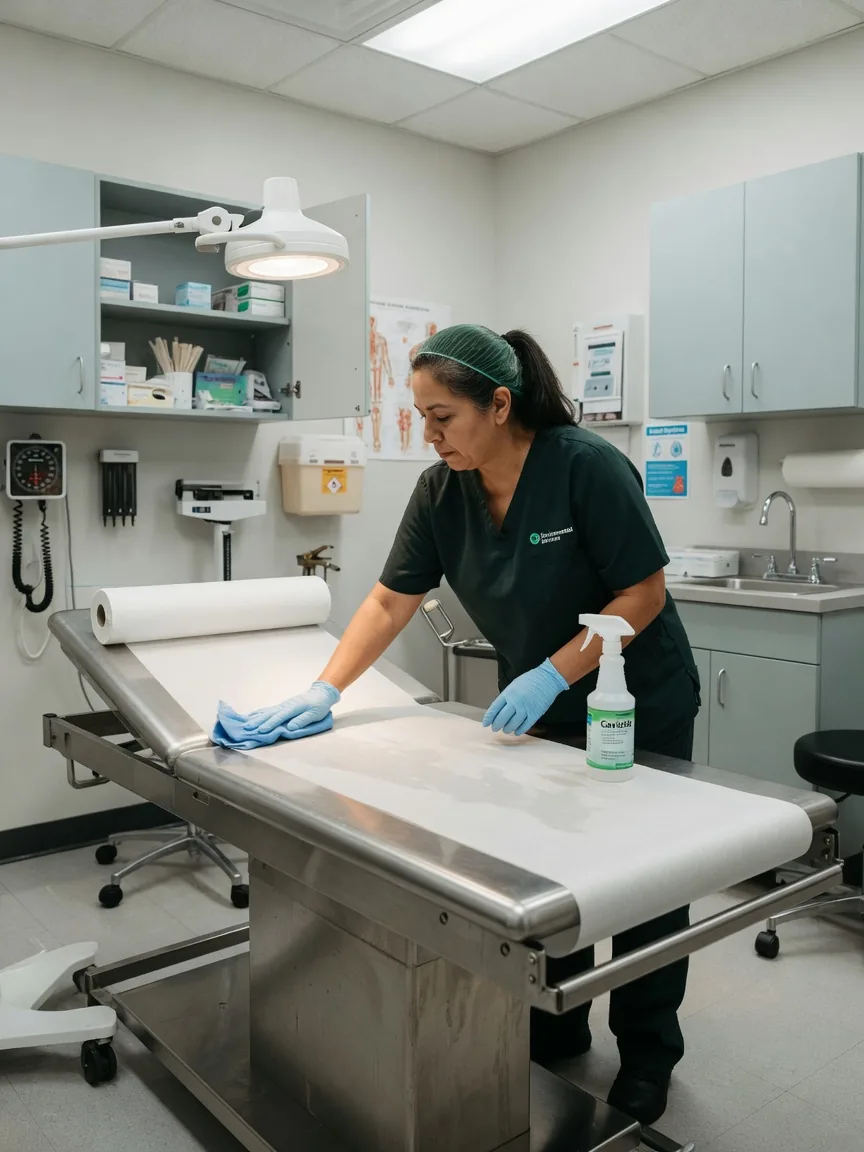
Spraying a disinfectant and wiping it off on the next pass does not disinfect — it redistributes. An EPA-registered hospital-grade disinfectant only kills the pathogens on its label if the surface stays visibly wet for the product's full contact (dwell) time (EPA, disinfectant use guidance). Depending on the product, that's anywhere from about 30 seconds to several minutes — and the most common audit failure in healthcare cleaning is exactly this: disinfectant wiped away before the dwell time is up.
A compliant vendor should be using EPA-registered disinfectants appropriate for the healthcare environment, applied per the manufacturer's label, with crews who know the contact time of the product in their hand. Surveyors in surgical settings literally ask staff to state the contact time — that's how fundamental it is.
Between-patient wipe-down vs. deeper terminal cleaning
There are two different jobs here, and they belong to different parties and service tiers:
- Between-patient exam-room wipe-down is typically done by clinical or practice staff during the day — disinfecting the exam table, counters, and high-touch points between patients. CDC guidance calls for more frequent cleaning of consultation and examination areas than of waiting areas (CDC, Environmental Cleaning Procedures).
- Scheduled janitorial disinfection — daily or per your SLA, usually before or after patient hours — covers the full facility: exam rooms, waiting and reception areas, restrooms, high-touch surfaces, floors, and back-of-house. This is the recurring medical cleaning program First Choice provides.
- Terminal cleaning is a distinct, higher service tier — the deep, documented clean of procedure and operating rooms to surgical standards, governed by stricter guidelines (e.g., AORN). It is a specialized capability, and most general medical-office cleaning programs do not include operating-room terminal cleaning or sterile instrument reprocessing. Treat it as a separate, premium scope and confirm explicitly whether any vendor actually performs it.
What infection-control practices separate a medical cleaner from an office cleaner?
The regulations set the floor; the day-to-day practices are where cross-contamination is actually prevented. A medical cleaning program should run on:
- Color-coded microfiber. Separate cloths and tools for clinical areas, restrooms, and common spaces, so a cloth never travels from a restroom to an exam room. This is the single most visible marker of a crew trained for healthcare.
- Clean-to-dirty sequence. CDC guidance is to proceed from cleaner to dirtier — clean areas before soiled ones — so contamination isn't dragged backward.
- High-touch surface discipline. Doorknobs, light switches, counters, exam-table rails, and shared-equipment exteriors get disinfected on a more frequent schedule than general housekeeping surfaces.
- Cross-contamination prevention end to end. Dedicated equipment, proper PPE, and procedures that keep clinical and non-clinical materials apart from cart to disposal.
How does a practice stay survey- and inspection-ready?
Accrediting bodies and state inspectors — Joint Commission, AAAHC for ambulatory and surgical settings, and Florida state health inspections — expect to see that cleaning actually happened to standard, not just that it was promised. In practice that means documentation: cleaning schedules and checklists, logs showing what was cleaned and when, the EPA registration and label contact time for each disinfectant in use, and Safety Data Sheets on file.
A cleaning vendor supports your inspection readiness by delivering consistent, documented service — written scope, scheduled cleaning logs, product documentation — that your infection-control program can point to during a survey. The vendor doesn't own your accreditation; it gives you the clean record and the paper trail that make passing easier.
What to require from your medical cleaning vendor
Vendor compliance checklist
- Written OSHA Exposure Control Plan (29 CFR 1910.1030) and documented annual bloodborne-pathogen training
- Hepatitis B vaccination offer and employer-provided PPE for exposed staff
- EPA-registered hospital-grade disinfectants, used for the full label contact time, with SDS on file (HazCom)
- Color-coded microfiber system and a clean-to-dirty cleaning sequence
- High-touch disinfection on a defined frequency
- Background-checked, privacy-aware crews; HIPAA-conscious conduct around incidental PHI
- Willingness to sign a BAA if your scope involves PHI handling
- Clear scope boundary: janitorial handles cleaning + non-regulated waste; regulated medical waste stays with your licensed medical-waste vendor; sterile instrument reprocessing stays with clinical staff
- Documented cleaning schedules/logs that support survey readiness (Joint Commission / AAAHC / Florida inspections)
- Bonded and insured, with a written SLA and a dedicated account contact
Standard commercial cleaning vs. compliant medical office cleaning
| Element | Standard Commercial Cleaning | Compliant Medical Office Cleaning |
|---|---|---|
| Disinfectants used | General-purpose cleaners; disinfection often incidental | EPA-registered hospital-grade disinfectants matched to pathogen risk |
| Dwell / contact-time discipline | Spray-and-wipe; contact time rarely tracked | Surface kept visibly wet for the full label contact time |
| Bloodborne-pathogen training | Not required; usually none | OSHA 29 CFR 1910.1030: written exposure control plan + documented annual training |
| PPE & Hepatitis B offer | Not typically provided | PPE provided; Hepatitis B vaccine offered to exposed staff |
| Color-coded equipment | Often shared cloths/tools across areas | Color-coded microfiber separating clinical, restroom, and common areas |
| Cleaning sequence | Convenience-based | Clean-to-dirty, high-touch surfaces prioritized (CDC guidance) |
| HIPAA / BAA willingness | Rarely considered | Privacy-aware crews; BAA signed when scope involves PHI |
| Documentation / logs | Minimal | Cleaning schedules, logs, SDS, product contact-time records for survey readiness |
| Service timing | During or after business hours | Scheduled around patient hours; between-patient vs. scheduled disinfection understood |
| Waste handling | General trash | Non-regulated waste only; regulated medical waste left to licensed medical-waste vendor |
Why this matters in the South Florida medical market
South Florida's tri-county medical market is dense and competitive — the medical corridors of Palm Beach County (West Palm Beach, Boca Raton), the hospital and specialty clusters across Broward (Fort Lauderdale, Pompano Beach, Coral Springs), and the heavy medical and healthcare concentration in Miami-Dade. Private practices, dental offices, urgent care, outpatient specialty, imaging, and physical-therapy clinics are everywhere, and they're all held to the same federal standards regardless of size.
For a practice manager here, the risk isn't finding a cleaning company — it's finding one that treats a medical office like a medical office instead of another suite of offices. The compliance standards above are the filter. First Choice provides medical office cleaning built around these protocols across Palm Beach, Broward, and Miami-Dade, in addition to general janitorial services and business and office cleaning for the non-clinical parts of your building.