Why is warehouse cleaning priced per square foot?
Per-square-foot pricing exists because floor area is the one variable every warehouse shares, so it gives buyers a common language for comparing bids. It's a useful unit for budgeting and for spotting an outlier quote.
But it's a blended figure, not a formula. A cleaning crew doesn't actually clean "square feet" — it cleans floors, dusts racking and overhead steel, wipes down dock areas, and removes forklift tire marks and dock dust, each at a different pace depending on the facility. The per-square-foot rate simply rolls all of that labor into a single number, which is why warehouses sit at the low end of commercial cleaning costs: they're large, open, lower-detail spaces compared to offices or medical suites. CleanQuote.org notes that labor is 50–70% of a commercial cleaning bill, which is the real reason floor area, layout, and crew speed drive the price more than anything else.
One-time deep clean vs. ongoing industrial janitorial — why they're priced differently
A one-time deep clean and an ongoing janitorial contract are two different products, and they're priced on different logic.
A one-off deep clean is mobilized once — crew, equipment, and setup all amortized across a single engagement, usually tackling built-up soil, high-bay dust, and floor grime that accumulated over months or years. That concentrated scope carries a higher effective per-square-foot cost. An ongoing program spreads lighter, repeatable work across regular visits, so each visit costs less per square foot. CleanQuote.org notes that higher frequency can lower the per-visit rate by roughly 5–15% through route efficiency — the crew learns the building, the soil load stays controlled, and there's no accumulated backlog to fight each time.
What drives the cost of cleaning a warehouse?
This is where the per-square-foot number gets decided. Here's how each factor moves the price:
- Total square footage. Bigger floors usually lower the per-square-foot rate. Fixed costs — mobilization, equipment transport, supervision — spread across more area, so a 200,000 sq ft facility often prices lower per foot than a 20,000 sq ft one.
- Ceiling height and high-bay areas. Tall buildings mean overhead steel, joists, light fixtures, and sprinkler lines collect dust that requires lifts or specialized reach equipment. High-bay dust removal is slower, more labor-intensive work, and it pushes the rate up.
- Floor type and finish. Bare concrete, sealed concrete, and coated/epoxy floors each clean differently. Bare concrete holds soil and demands more aggressive scrubbing; sealed and coated surfaces clean faster but have maintenance requirements of their own. The finish dictates method, and method dictates labor.
- Racking density and layout. Packed selective racking slows a crew down — tight aisles, limited equipment maneuvering room, and more hand-detailing around stored product. Open, sparsely racked floor space cleans fast; a densely slotted facility of the same square footage does not.
- Frequency. Recurring service lowers the per-visit cost versus a one-off deep clean. Daily or five-day programs keep soil load manageable and gain route efficiency; infrequent or one-time cleans fight accumulated buildup and cost more per square foot.
- Soil and dust load. Dock dust, forklift tire marks, grease near equipment, and general industrial debris all add time. A clean-running distribution center is cheaper to maintain than a high-traffic or messy manufacturing floor.
- Food-grade and cold-storage environments. These carry stricter protocols, sanitation requirements, and documentation — which raises cost. Sparkle Pro's 2026 guide specifically notes that complex sites like food-grade or heavy-soil facilities can exceed $0.20 per square foot per month.
- Dock doors, loading bays, and exterior apron. These high-traffic transition zones collect the heaviest soil and often need separate attention, including pressure washing on the exterior apron.
- After-hours or around-shift scheduling. Cleaning around an active operation — phased work between shifts, or overnight crews — carries a labor premium and coordination overhead that a vacant-building clean does not.
To put scale on it, Sparkle Pro illustrates a 100,000 sq ft facility at a $0.15 midpoint at roughly $15,000 per month — a useful reference point, though your own number depends on the factors above.
How much does warehouse floor cleaning cost on its own?
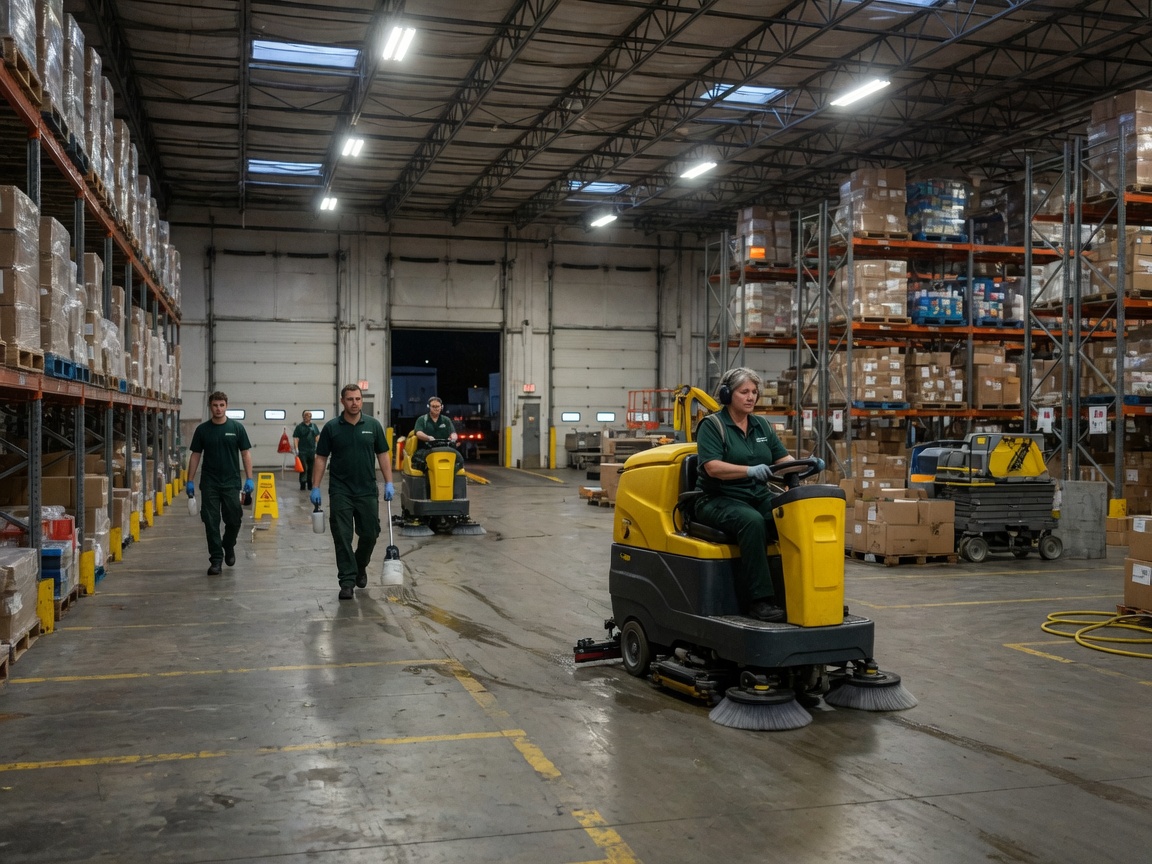
Floor cleaning is often the single largest line in a warehouse program, and it's frequently quoted as its own scope. The two core methods are ride-on or walk-behind auto-scrubbing for general soil and dust, and degreasing for oil, grease, and heavy buildup near equipment and traffic lanes.
The specific rate depends on floor type, square footage, and how much hand-detailing the racking layout forces. One point worth being direct about: for coated or epoxy floors, First Choice cleans and maintains the existing finish — we don't install epoxy. If you want a durable, cleanable hard-floor system, our in-house alternative is concrete polishing and sealing, which produces a dense, low-maintenance surface without a coating to peel or delaminate. For the day-to-day scope, see our warehouse floor cleaning and commercial floor cleaning and auto-scrubbing services.
What does a warehouse cleaning quote usually include — and exclude?
A standard recurring warehouse quote generally covers the routine, repeatable work: floor sweeping and auto-scrubbing of open areas, trash removal, restroom and breakroom cleaning, and wipe-downs of common touchpoints and office areas within the facility. That's the baseline most per-square-foot numbers are built around.
Common add-ons
Beyond the baseline, these are typically scoped and priced separately:
- High-bay and overhead dust removal — joists, beams, fixtures, and sprinkler lines, usually requiring lifts.
- Dock and door cleaning — loading bays, dock plates, and door tracks that collect concentrated soil.
- Degreasing — oil and grease near equipment, maintenance areas, and forklift lanes.
- Machine floor scrubbing — periodic deep scrubbing beyond routine maintenance.
- Exterior apron pressure washing — the concrete outside the dock doors. See commercial pressure washing.
What a per-sq-ft number does NOT cover
A per-square-foot figure is for routine cleaning. It generally does not include restoration-level work — one-time deep cleans of a neglected facility, post-construction cleanup, specialty floor restoration, or emergency cleanup after a spill or storm. It also doesn't cover consumables restocking unless that's written into the scope. When you compare bids, confirm what's baseline versus add-on, because a low headline rate often means a thinner scope.
How to get an accurate warehouse cleaning quote in South Florida
A phone estimate is a guess; a walkthrough is a quote. The factors that actually set your price — ceiling height, floor condition, racking density, soil load — are things a cleaning company needs to see in person to price honestly.
To make a walkthrough productive, have this ready:
- Total square footage (and a rough breakdown of warehouse vs. office/mezzanine area)
- Ceiling height and whether there are high-bay or overhead areas needing dust removal
- Floor type and finish — bare, sealed, or coated/epoxy concrete
- Racking layout and density — how much of the floor is open vs. packed selective racking
- Shift schedule and access windows — when the building is available and whether work must happen around active operations
- Any special environment — food-grade, cold storage, or heavy-soil manufacturing
If you're also budgeting for office or administrative space in the building, it's worth understanding how commercial office cleaning is priced per square foot, since that area is priced on different logic than open warehouse floor. For the full day-to-day scope, see our professional warehouse cleaning service.