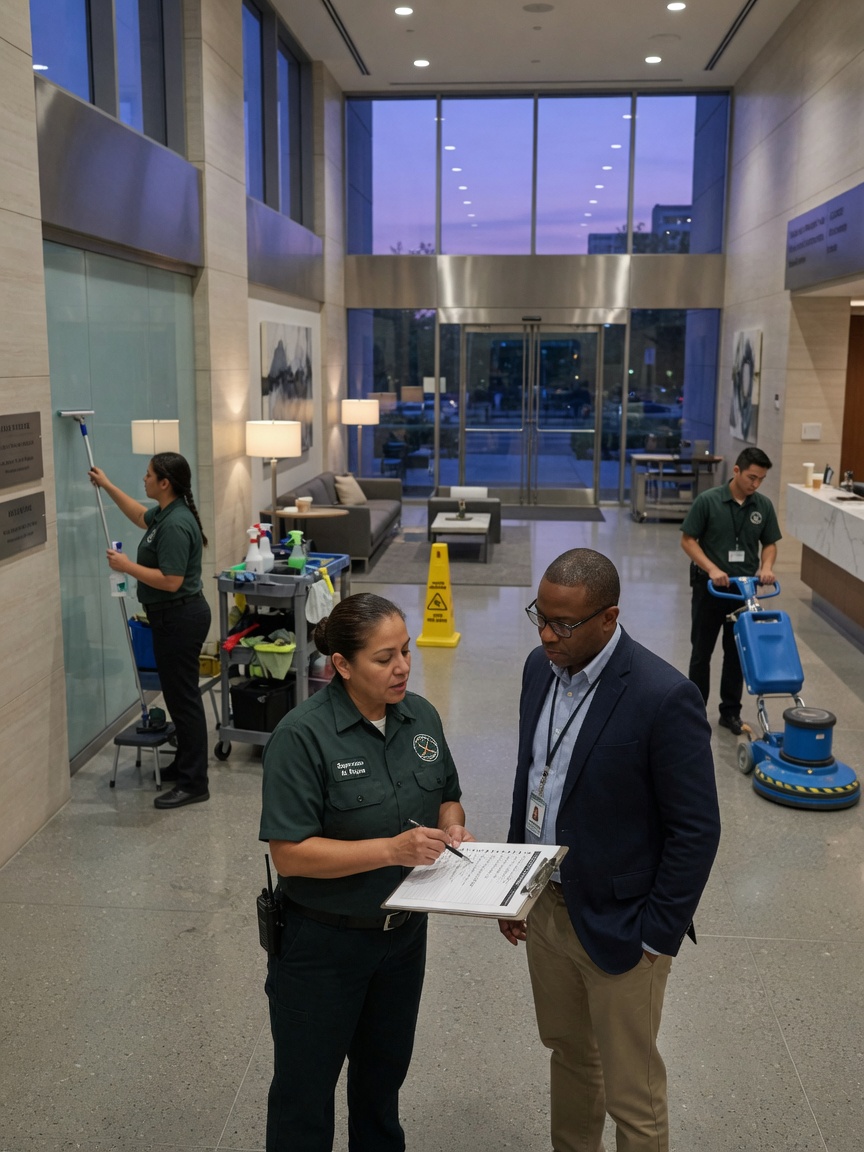
Why the questions you ask matter more than the price you're quoted
A janitorial contract is not a one-time purchase — it's a recurring service relationship you'll live with every night or every week. The dollar figure on the bid tells you almost nothing about what you're actually buying. What you're buying is labor hours, trained people, and accountability, and none of those are visible in a bottom-line price.
Two companies can quote the same building and land 30% apart, and the gap is almost always hours. A lower bid usually means fewer budgeted labor hours, which means tasks get skipped, corners get skipped, or the crew rushes. The questions below exist to make the invisible part of the bid visible before you sign, not after the first complaint rolls in.
The questions to ask a commercial cleaning company before hiring
Insurance, bonding & liability — are they actually covered on your site?
Ask for current certificates of insurance, not a verbal "we're covered." A qualified commercial cleaning vendor should carry general liability, workers' compensation (required of employers in Florida), and a janitorial (surety) bond, and should be willing to name your business as additional insured on the policy — naming the client as additional insured is a standard commercial-contracting request, not a special favor. Rather than fixating on a specific coverage limit, confirm the policies exist, are current, and match the scale of your building.
Why it matters: if an uninsured cleaner is injured in your building or damages property, the exposure can land on you. Ask that the certificate be sent directly from their insurer or agent, and that you be notified on renewal so coverage never lapses mid-contract.
Who actually cleans your building — employees or subcontractors?
Ask directly whether the people in your building are the company's own W-2 employees or subcontracted labor. In-house, background-checked employees generally mean more accountability and more consistency than rotating subcontractors — which matters most in occupied and multi-tenant buildings where the same faces should be showing up.
Follow up on vetting: are workers background-checked? Is employment verified through E-Verify? Do crews wear uniforms and carry visible ID? In a building with tenants, after-hours access, and sensitive areas, "who is in my building at 9 p.m." is not a small question.
Training & turnover — who shows up, and do they know what they're doing?
Ask how new cleaners are onboarded and what ongoing training they receive. For any site with medical, lab, or restroom-heavy scope, ask specifically about OSHA and bloodborne-pathogen training where relevant. A company that can describe its training program usually has one; a company that waves the question off usually doesn't.
Turnover is the quiet killer of cleaning quality. Industry reports on building-service contractors routinely put annual janitorial turnover in the triple digits — frequently cited in the range of roughly 100% to 200% a year (building-service-contractor industry estimates, 2024–2026), far above most other service sectors. Whatever the exact figure for any one company, the point is practical: ask what their turnover is and how they cover call-outs so your building still gets cleaned when someone doesn't show.
Supervision & quality control — how do they know the work got done?
Ask whether your account gets a named site supervisor and how often the work is inspected. A real quality-control program has structure: scheduled inspections, a scorecard or checklist, and documentation you can see. "We check in sometimes" is not a QC program.
The useful test is whether they can show you a sample inspection form or describe their cadence without hesitating. Documented work is the difference between catching a missed restroom on their inspection versus catching it from a tenant complaint.
Scope & schedule — exactly what, how often, and when?
Get the scope of work in writing, task by task, with frequency attached to each line: nightly, weekly, or periodic. A vague scope ("general office cleaning") is where disputes live; a line-item scope ("restrooms disinfected nightly, carpets vacuumed nightly, hard floors machine-scrubbed monthly") is enforceable.
Also settle the schedule model: do you need a day porter present during business hours, after-hours cleaning once the building empties, or both? And in an occupied building, pin down access — keys, alarm codes, badge handling, and who is accountable for securing the space on the way out. If you're unsure how often each area actually needs attention, our breakdown of how often a commercial office should be cleaned walks through frequency by area and facility type.
Communication & issue resolution — what happens when something's missed?
Ask who your single point of contact is and how fast they respond. Every cleaning company misses something eventually; the ones worth hiring have a defined path for correcting it. Ask what their response time is and how a missed clean gets made right — a same-night return, a next-day re-clean, or a credit.
A clear answer here tells you they've handled complaints before and built a process around them. A vague answer tells you you'll be the one chasing them down.
Supplies, equipment & green cleaning — who provides what, and in what condition?
Clarify who supplies consumables (paper, soap, liners) and whether that's inside the price or billed separately — this is a common source of surprise charges. Ask about the condition and age of their equipment, since worn vacuums and dirty mop systems move soil around instead of removing it.
If indoor air quality or tenant sensitivity matters in your building, ask whether they offer certified green cleaning products — look for recognized third-party certifications rather than a vendor's own "eco-friendly" label with nothing behind it. Green Seal's GS-37 standard, for example, certifies general-purpose, glass, bathroom, and carpet cleaners for industrial and institutional use against defined health and environmental criteria (greenseal.org), which is a verifiable claim in a way a self-applied "green" sticker is not.
References & tenure — have they done this here, in buildings like yours?
Ask for references from similar South Florida facilities — a medical suite reference means little if you run a 60,000-square-foot warehouse. Ask how long those clients have been with them. Long client tenure is one of the most honest signals in this industry, because unhappy commercial clients leave.
Local presence matters too. A vendor with real tri-county supervision can get someone to your site tonight; a far-flung operator subcontracting locally cannot.
Contract terms — what are you actually locked into?
Read the term length, the cancellation and exit clause, and the price-escalation language before you sign. A fair contract gives you a reasonable out (commonly a notice period) if service slips, rather than locking you in for years with no recourse. Ask how and when prices escalate, and get the proof-of-insurance renewal obligation in writing so coverage can't quietly lapse.
How to compare and score commercial cleaning bids
Normalize the bids first
You cannot compare three bids until all three are pricing the same thing. Before you look at a single dollar figure, confirm every vendor quoted the identical scope, the identical frequency, and the same square footage. If one bid assumes nightly service and another assumes three nights a week, the "cheaper" one isn't cheaper — it's a different service.
The fastest way to normalize is to hand every vendor the same written scope and have them price against it. If you want a sense of what a normalized number should look like per square foot, see our breakdown of commercial office cleaning cost per square foot.
A simple weighted scorecard
Once bids are normalized, score them instead of eyeballing them. Weight the factors by what actually drives outcomes — price matters, but so do staffing hours, insurance, and supervision. The table below is an illustrative weighting you can adjust to your building; it is an example framework, not data from any specific account.
| Factor | Example weight | What you're scoring |
|---|---|---|
| Price (normalized) | 25% | Cost against the identical scope, not the lowest absolute number |
| Scope completeness | 20% | Line-item tasks + frequencies, nothing vague |
| Staffing hours budgeted | 20% | Labor hours actually shown for your building |
| Insurance & compliance | 15% | GL, workers' comp, bond, additional-insured willingness |
| Supervision & QC | 10% | Named supervisor, inspection cadence, documentation |
| References & tenure | 10% | Comparable facilities, client longevity, local presence |
Score each bid 1–5 per factor, multiply by the weight, and total it. The winner is rarely the cheapest line — it's the bid that holds up across all six.
Red flags in a bid
A few signals should slow you down regardless of price: a vague scope with no task frequencies, no labor hours shown anywhere, no proof of insurance offered, no supervision or QC line item, and a price sitting far below the rest of the field. When one bid is dramatically cheaper than three others pricing the same scope, that's not a deal — it's a warning that hours, insurance, or supervision got cut to hit the number.
Why the cheapest commercial cleaning quote is the riskiest
When a bid comes in well under the pack, something was removed to get there, and it's almost always one of three things: labor hours, properly trained or stable staff, or supervision and insurance. None of those cuts are visible on day one. They show up over the following months as skipped tasks, re-cleans, tenant complaints, and a crew that turns over faster than you can learn their names.
The hidden cost compounds. You spend management time chasing corrections, you field tenant or employee complaints, and within a year you're re-bidding the contract — which costs you the walkthrough, the onboarding, and the disruption all over again. A fair mid-range bid isn't paying a premium; it's paying for the hours, people, and accountability that keep you out of that cycle.
A pre-hire checklist you can use on your next bid walkthrough
- Current certificates of insurance (GL, workers' comp, janitorial bond) + willingness to name you as additional insured
- Employees vs. subcontractors; background checks, E-Verify, uniforms/ID
- Onboarding and training program; OSHA/bloodborne-pathogen training where relevant
- Turnover rate and call-out coverage plan
- Named site supervisor + inspection cadence + sample scorecard
- Written, line-item scope with frequency on every task
- Schedule model (day porter / after-hours / both) and access-and-alarm handling
- Single point of contact, response time, and missed-clean correction process
- Who supplies consumables; equipment condition; certified green options if needed
- References from comparable South Florida facilities + client tenure
- Contract term, exit clause, price escalation, insurance-renewal obligation
Hiring a commercial cleaning company in South Florida
South Florida adds its own variables. Most contracts here are for occupied, often multi-tenant buildings, which raises the stakes on access control, after-hours security, and crews that show up consistently. The climate matters too: year-round humidity drives mold and restroom demands, and hurricane season can trigger one-off cleanup needs on top of the recurring scope. Local supervision isn't a nice-to-have when weather or a call-out means someone has to reach your site tonight.
First Choice Commercial Cleaning is a locally operated, insured, background-checked tri-county vendor serving Palm Beach, Broward, and Miami-Dade. If you're comparing bids, the fairest path is a scoped walkthrough so every vendor — including us — is pricing the same building. See our commercial janitorial services for scope, or our business office cleaning and commercial building cleaning pages for how we handle occupied and multi-tenant sites.