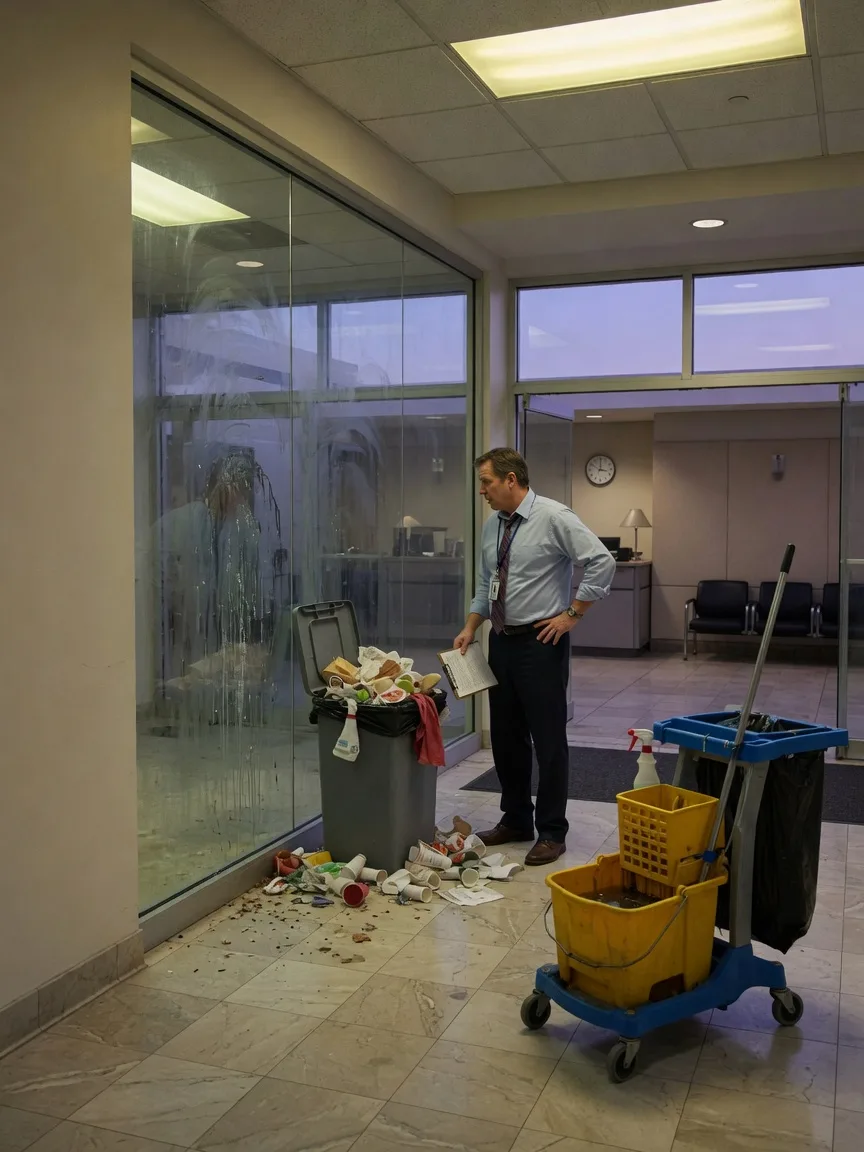
Most cleaning contracts don't fail overnight. They slip. The first few weeks are sharp, the floors shine, the trash is always empty — and then, somewhere around month three or four, the quality quietly drifts downward while the invoice stays exactly the same. By the time a facility manager notices, the decline has usually been visible on the floor for weeks.
The signs below are the ones that reliably separate a vendor having a bad week from a vendor that is structurally failing your account. Watch for patterns, not single incidents. One missed trash can is noise; a trend is a decision point.
1. Cleaning quality is inconsistent or getting worse
The most common early warning sign is uneven quality — spotless one visit, visibly skipped the next. Restrooms that smell fine on Monday and stale by Wednesday. Conference tables wiped but baseboards, vents, and glass partitions untouched for weeks.
Inconsistency almost always traces back to a staffing or supervision problem on the vendor's side, not a one-time miss. If you're finding yourself doing a "white glove" check after every visit, the vendor's own quality control has already broken down. A healthy janitorial operation inspects its own work before you ever have to.
2. Visits are missed, shortened, or skipped without notice
Watch the clock, not just the floor. A crew scheduled for a two-hour nightly service that's in and out in 35 minutes is not completing the scope you're paying for — they're cherry-picking the visible tasks and skipping the rotational work (high dusting, edge detailing, floor maintenance, restocking back-of-house).
Missed visits with no proactive call are an even clearer signal. A vendor that's managing your account properly tells you before you notice a gap. When you're the one discovering a skipped night, their dispatch and supervision layer isn't functioning.
3. High cleaner turnover and no on-site supervision or QC
Commercial cleaning is a high-turnover industry, and some churn is normal. The problem is unmanaged churn — a different face in your building every few weeks, nobody trained on your specific scope, and no supervisor ever setting foot on site.
When there's no account supervisor doing periodic walkthroughs and no documented quality-control process, every new cleaner relearns your building by trial and error, and the errors land on your floor. Ask your vendor directly: who supervises this account, how often do they inspect, and what does their QC checklist cover? A failing vendor won't have a clean answer.
4. Communication has broken down
Healthy vendor relationships have a named point of contact who answers. A failing one has a phone tree, a generic inbox, and a growing lag between your message and any human reply.
The tell isn't just slow response — it's vanishing response. Emails that used to get answered same-day now take a week. The account manager who onboarded you has quietly left and nobody introduced a replacement. When communication goes dark, service problems stop getting solved because there's no longer anyone accountable for solving them.
5. Complaints get no response (or the same issue keeps recurring) — the strongest fire signal
This is the signal that matters most. Any vendor will have a complaint now and then; what separates a fixable relationship from a failing one is what happens after you raise it.
If you report the same issue two or three times and it keeps coming back, the vendor either can't fix it or isn't trying. A recurring complaint means the corrective loop — report, assign, fix, verify — is broken somewhere inside their operation. When documented problems don't get resolved after you've clearly flagged them, you've moved from "give them a chance" to "start planning the switch." This is the clearest justification for termination of the ones on this list.
6. Insurance, bonding, or background-check standards have lapsed
This one isn't about cleanliness — it's about liability, and it's non-negotiable. Your cleaning crew has after-hours keys or access codes to your building. If their general liability insurance has lapsed, their bonding has expired, or they've stopped background-checking the people they send into your space, your organization is exposed.
Ask for a current certificate of insurance (COI) on renewal and spot-check it mid-contract. A vendor that goes quiet or stalls when you request proof of current coverage is a vendor you should treat as a live risk, not a slow responder. For any facility with security, tenant-safety, or compliance obligations, a lapse here is grounds to move immediately.
7. Scope creep and nickel-and-diming
The last sign is financial, not operational. The scope you agreed to starts quietly shrinking — tasks that were "included" become line-item add-ons, "that's not in your contract" becomes a frequent answer, and surprise charges appear for work you assumed was baseline.
Scope creep in reverse is how a declining vendor protects its margin while cutting its labor on your account. If your effective cost-per-clean is rising while the actual work is shrinking, the relationship has stopped delivering the value you signed up for — even if no single invoice looks outrageous.
Should you give your cleaning company a chance to fix it, or fire them now?
Not every warning sign warrants immediate termination. The right call depends on which sign you're seeing and whether you've given the vendor a real, documented chance to correct it.
Give them a chance to cure when:
- The issue is quality or consistency and you haven't yet raised it in writing
- There's a named, responsive account manager still engaged
- The problem is recent and you can point to a specific cause (seasonal staffing, a crew change) the vendor is openly working to fix
- Insurance, security, and compliance are all intact
Fire now — don't wait — when:
- Documented problems persist after a clear written warning
- Insurance or bonding has lapsed and they can't produce a current COI
- There's been a security breach, a theft, or an access/key-control failure
- Communication has gone fully dark and no one is accountable for the account
The escalation path in between is straightforward and protects you either way:
- Document with dates and photos. Build a log — date, visit, what was missed, a photo where it's visible. A paper trail converts "they're slipping" into evidence, which is what you'll need whether the vendor improves or you terminate.
- Issue a written cure notice. One clear, written chance to fix specific, named issues within a stated window. Most commercial cleaning agreements build in an "opportunity to cure" before you can terminate for cause — but your specific contract controls, so confirm the language in yours.
- Review your contract's termination terms and give proper notice. Before you make any move, read the exit clause so you don't trade a cleaning problem for a breach-of-contract problem.
How do you actually switch cleaning companies once you've decided?
Once you've decided to replace a failing vendor, the mechanics matter as much as the decision. The two biggest mistakes are terminating before you understand your own contract's exit terms, and letting the old vendor walk before the new one starts — leaving your building with a service gap.
Start with your contract. Nearly every commercial cleaning agreement has a notice period — these commonly fall in the 30-to-90-day range, and auto-renewal clauses can quietly lock you in if you miss the window. These are general commercial-contract norms, not a universal rule, so your own agreement is what controls. We walk through exactly how to read and exit the agreement cleanly — including notice windows, for-cause vs. for-convenience termination, and auto-renewal traps — in how to get out of a commercial cleaning contract.
Then overlap the transition. Line up your replacement vendor and, where possible, schedule a short overlap — a few days where the new crew is onboarding and walking the building before the old contract officially ends. That overlap is what prevents a dirty-building gap during the handoff, and it gives the incoming team a chance to document the building's starting condition. When you're vetting that replacement, questions to ask before hiring a commercial cleaning company covers what to confirm before you sign — supervision model, insurance, scope, and QC process.
If you're evaluating a replacement for a failing business office cleaning vendor, the right starting point is a walkthrough that puts the new provider's scope and supervision in writing before anything is signed.