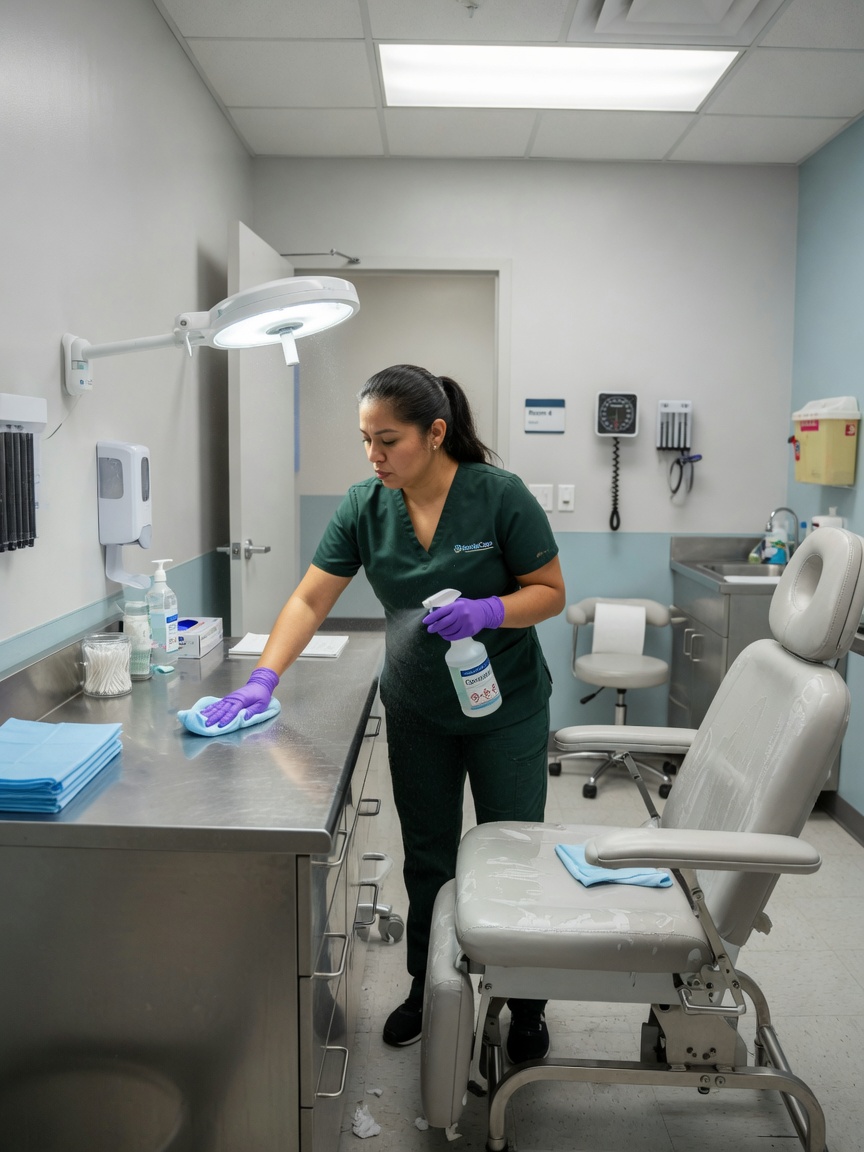
Why does medical office cleaning cost more than regular office cleaning?
Because the work is governed by published compliance standards that standard office cleaning is not, and those standards add labor, training, products, and process to every visit. Three regulatory drivers do most of the work:
HIPAA and PHI handling. Under HIPAA, administered by the U.S. Department of Health and Human Services, cleaning crews work in spaces where protected health information is present on charts, screens, and paperwork. That means medical cleaning calls for vetted, background-checked staff and trained handling protocols rather than a general labor pool.
OSHA Bloodborne Pathogens Standard, 29 CFR 1910.1030. This published OSHA standard governs how surfaces and regulated waste that may carry blood or other potentially infectious materials are handled, decontaminated, and disposed of. It dictates protective equipment, decontamination procedure, and the boundary between janitorial cleaning and regulated medical waste — all of which add time and training to each visit.
EPA-registered disinfectant contact time. EPA-registered hospital-grade disinfectants only work if the surface stays visibly wet for the full contact (dwell) time printed on the label. On an exam-room counter or treatment chair, the surface can't simply be wiped and moved past — it has to be treated, left to dwell, and often re-wetted. That extra dwell time is labor, and labor is cost.
None of that applies to a standard open-plan office. These are published federal requirements that drive the cost and scope of medical cleaning — not certifications any single vendor holds — and the gap between them and ordinary office work is the core reason the per-square-foot rate runs higher.
What are the main variables that set the per-square-foot rate?
How does facility type change the cost?
Medical facilities sit on an escalating tier, and where your facility lands is one of the biggest rate drivers. The more clinical the space, the more surface area has to be treated to a disinfection standard rather than merely cleaned — and the per-square-foot figure rises accordingly. Here is how published 2026 per-visit benchmarks break down by facility type (CleanEstimator, 2026 Medical Office Cleaning Cost guide):
| Facility type | Published per-visit rate (per sq ft) |
|---|---|
| Standard office (for comparison) | $0.088 – $0.107 |
| General medical office / clinic | $0.150 – $0.185 |
| Dental office | $0.200 – $0.350 |
| Urgent care | $0.250 – $0.400 |
| Lab / diagnostic / imaging | $0.300 – $0.500 |
| Outpatient surgery center | $0.350 – $0.600 |
National benchmark ranges published by CleanEstimator (2026); actual rates vary by market, frequency, and scope. These are not First Choice prices.
First Choice provides medical cleaning for medical and dental offices, clinics and urgent care, outpatient and specialty practices, physical therapy and rehab centers, diagnostic, lab, and imaging centers, and behavioral health practices across South Florida. Full surgical-suite terminal cleaning and regulated medical-waste disposal are specialized services that stay with your clinical staff and a licensed medical-waste vendor — a boundary any reputable medical office cleaning program should state plainly.
Does cleaning frequency change the cost per square foot?
Yes — frequency is one of the largest levers on both the per-square-foot rate and total monthly spend. A facility cleaned daily carries a different per-visit economics profile than one cleaned three times a week or weekly. Daily service often lowers the per-visit cost because the soil load per visit is smaller, but it raises total monthly spend because there are more visits. Weekly service does the opposite.
As an illustration of that spread, CleanEstimator's 2026 guide prices a 2,000-square-foot medical office at roughly $1,200–$1,480 per month cleaned weekly versus roughly $6,510–$8,030 per month cleaned five days a week — the same space, driven almost entirely by how often a crew shows up. Exam-room turnover is usually what forces higher frequency: a high-volume practice cycling patients through rooms all day accumulates high-touch contamination faster than a low-volume specialist. When you compare quotes, compare them on the same frequency — a "cheaper" bid is often just a lower frequency.
How do exam-room count and turnover affect scope?
Room count and high-touch density drive the labor inside each visit. Ten exam rooms take meaningfully longer to disinfect than three, even at the same total square footage, because each room has its own set of high-touch surfaces: exam tables, chairs, counters, light handles, cabinet pulls, and equipment exteriors.
There's also a difference between standard surface cleaning and between-patient or terminal-style disinfection. Most janitorial contracts cover end-of-day or scheduled disinfection, not between-patient room turns — but a bid should state clearly which it includes, because the two are very different labor commitments.
Is after-hours medical cleaning more expensive?
Generally, yes. Cleaning that happens around patient hours during the day is one thing; after-hours or weekend access — so crews aren't working around patients and staff — commonly carries a premium, because it ties up labor outside standard shifts. Many medical practices still prefer after-hours service so disinfection happens on empty, undisturbed rooms. That preference is legitimate; just price it in rather than being surprised by it.
How do square footage and building type affect the rate?
Larger facilities usually see a lower per-square-foot rate because of economies of scale — the fixed cost of mobilizing a crew is spread across more area. A 2,000-square-foot clinic and a 20,000-square-foot medical office building will not carry the same per-square-foot number, even at the same frequency and disinfection level.
Building composition matters too. Labs, soiled-utility rooms, and restrooms are priced differently from open office or administrative areas, because they demand more intensive disinfection and, in some cases, regulated-waste awareness. A bid that prices your whole facility at a single blended rate without accounting for these zones is oversimplifying.
How is medical office cleaning actually priced?
Vendors quote medical cleaning three common ways:
- Per square foot — useful for budgeting and apples-to-apples comparison, but only meaningful once frequency and disinfection level are fixed.
- Flat monthly — the most common contract format; rolls square footage, frequency, and scope into one recurring number.
- Per visit — used for lower-frequency or as-needed arrangements.
Here's the practical point: any reputable medical cleaning vendor quotes after a walkthrough, not over the phone from a square-footage number alone. The walkthrough is where room count, high-touch density, lab and soiled-utility zones, after-hours access, and disinfection scope get established — and those are exactly the variables that move the price.
A medical cleaning bid should itemize, at minimum: the disinfection protocol (which surfaces, what disinfection standard, dwell-time handling); the products used (EPA-registered hospital-grade disinfectants vs. general cleaners); the cleaning frequency per area; and the regulated-waste boundaries — what the cleaning crew handles versus what stays with the practice's medical-waste contractor under OSHA 29 CFR 1910.1030. If a bid doesn't itemize those, you can't compare it to another bid, and you can't verify it covers what your compliance posture requires. A vague bid is a risk, not a bargain.
For a side-by-side on how standard office pricing works — and why medical sits above it — see our companion guide on commercial office cleaning cost per square foot. And for the detail behind the compliance drivers above, see HIPAA and OSHA requirements for medical cleaning.
What does medical cleaning cost in South Florida specifically?
There's no single local price figure worth quoting, because the variables above swamp any flat number — but the South Florida context does shape demand. Miami-Dade and Palm Beach counties both have dense medical corridors, with heavy concentrations of clinics, specialist practices, and surgery centers. That density means a competitive market, but it also means facilities that take infection control seriously and expect vendors who understand medical scope rather than general office janitorial.
First Choice services all three counties — Palm Beach, Broward, and Miami-Dade — so a tri-county practice or a group with multiple locations can run a consistent protocol across sites. Standard, non-clinical administrative space in a medical building is priced much like any standard commercial office cleaning account; the clinical areas are what carry the premium.
What should I do to get an accurate quote?
Get a walkthrough-based quote, and come to it prepared. Having the following ready lets a vendor give you a real number instead of a wide range:
- Total square footage and a rough breakdown by zone (exam rooms, labs, restrooms, admin/office).
- Exam-room count and approximate patient volume — it drives frequency.
- Desired cleaning frequency (daily, 3x/week, weekly).
- Access window — can crews work during patient hours, or do you need after-hours/weekend access?
- Any specific disinfection protocol your practice or accreditor requires.
With those in hand, the walkthrough is quick and the quote is accurate — and you can hold every bid you receive to the same scope.